Death at The Fifty-Five Fifty! Someone DIED in unit 335.

5550 Tenants Association: Empowering Renters
We empower 5550 Hollywood residents, provide renter support, and warn prospective 5550 renters about tenant rights.
Death at The Fifty-Five Fifty! Someone DIED in unit 335.
We empower 5550 Hollywood residents, provide renter support, and warn prospective 5550 renters about tenant rights.

There is something deeply backwards happening at Fifty-Five Fifty.
Senior Property Manager Josh Vasquez works for a company that tenants pay to operate their homes. He is not their king. He is not their warden. And residents are not peasants who should be expected to tremble when management sends another notice, demands another inspection, or dispatches another employee to their doors.
Yet that is increasingly how life at 5550 Hollywood Boulevard feels to some residents.
Consider Kevin, a longtime resident who has lived at Fifty-Five Fifty for roughly six years and now faces displacement from the place he has called home. The prospect of a longtime resident losing his housing should be treated as a human catastrophe—not another administrative file to be processed.
Meanwhile, the chair of the Fifty-Five Fifty Tenants Association says he has faced an escalating barrage of notices, accusations, and inspections as his tenant organizing has become more visible.
Among management’s allegations were supposed problems involving objects hanging from or interfering with fire sprinklers. Then an actual professional sprinkler inspection took place.
The tenants association chair says the inspector told him everything was fine.
He says the inspector identified no object hanging from, attached to, or interfering with a sprinkler.
So what exactly was all the drama about?
Management has also returned the association chair’s rent check. The chair says he has repeatedly confirmed that he will provide lawful access to his apartment. Yet management’s scrutiny continues.
At some point, residents are entitled to ask whether this is ordinary property management or management by intimidation.
Management apparently has plenty of energy for notices and inspections.
But the tenants association has also documented what it says are serious concerns elsewhere at the property—from security and garage problems to building conditions and disputes over amenities.
And then there was the refrigerator.
The association has previously raised concerns about a discarded refrigerator being left accessible with its doors attached—a basic safety issue that hardly inspires confidence in a management operation simultaneously scrutinizing what residents allegedly have near their sprinklers.
Perhaps the people inspecting tenants should spend a little more time inspecting themselves.
There was also the strange saga of complimentary soda. Tenants were not always made conspicuously aware that drinks were available through the leasing office, according to the association.
Why?
We cannot know what was going through anyone’s head. Maybe there was an innocent explanation.
But in a building already suffering from a profound breakdown in trust between management and organized tenants, even something as ridiculous as soda becomes symbolic: management controls it, management knows about it, and residents are left wondering why nobody bothered to tell them.
Perhaps the most disturbing questions involve security.
The building’s security operation has been described to residents as a courtesy-patrol-style, observe-and-report function. Yet the tenants association says armed guards have appeared at the property and that security personnel have communicated directly with Vasquez concerning residents.
That deserves an explanation.
Who authorized armed personnel? What are their instructions? What authority are they supposed to exercise over tenants? When they contact Vasquez about residents, what information is exchanged? And, most importantly, are security officers being placed in the middle of management’s disputes with tenants?
The guards themselves may be in an impossible position. They are workers following instructions, and there is no reason to assume they devised management policy.
That makes the question for Vasquez even more important:
What exactly are you telling them to do?
Residents should never have to wonder whether the person standing downstairs with a weapon is there to protect them or to enforce the whims of property management.
Vasquez may walk his dog down Hollywood Boulevard like any other resident of the neighborhood.
But when he returns to Fifty-Five Fifty, he should remember something.
The tenants are not his subjects.
The apartment building is not his personal kingdom. Notices are not royal decrees. Security guards are not palace guards. The leasing office is not a throne room.
And a tenants association is not an insurrection.
It is residents exercising their right to organize around the conditions of the place where they live.
Above Vasquez sit other Avenue5 executives, including Tony Gallo and property management personnel including Taylor Dow. They, too, should answer for the management culture developing at this property.
Avenue5 is a professional property-management company. Its job is to manage housing—not to wage personal wars with the people living in it.
Residents naturally understand that a management company collects money. That is the business.
But when residents see new charges and disputes over services occurring alongside persistent building complaints, while the most visible tenant organizer simultaneously faces escalating management attention, they are entitled to demand answers about the company’s priorities.
How much energy is being spent improving Fifty-Five Fifty—and how much is being spent fighting the people demanding that it be improved?
That is the question Avenue5, Vasquez, Dow, and Gallo should have to answer.
Because whatever title appears beneath Josh Vasquez’s name, there is one title he does not possess:
King of Fifty-Five Fifty.
The people living inside the building are customers, tenants, and human beings.
They pay for their homes.
They have rights.
And they do not work for Josh Vasquez.
He works for the company they pay.
Tell Josh that whatever HE MAY THINK, he is not your king.
We are free tenants DEMANDNG our rights. Not peasants serving some tyrant.
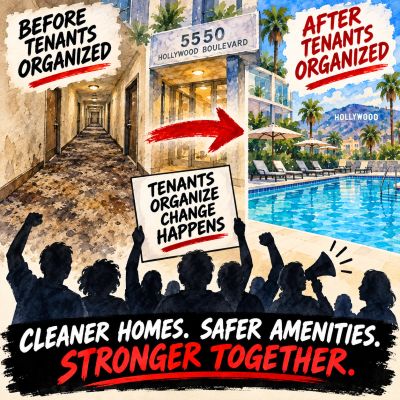
LOS ANGELES — For years, residents of Fifty-Five Fifty walked across filthy, stained, deteriorating hallway carpets.
Year after year, the carpets remained.
Complaints came and went. Residents paid their rent. Management collected it.
Still, the carpets stayed.
Then something changed.
The tenants organized.
After roughly eight years, the old carpets were finally replaced—and the Fifty-Five Fifty Tenants Association believes sustained organizing pressure from residents is the reason management finally acted.
Funny how quickly the impossible becomes possible when tenants start speaking with one voice.
The same pattern played out with one of the building’s marquee amenities.
Residents had been paying to live in a complex marketed with a pool and spa. But after years of alleged inadequate upkeep and deteriorating conditions, the amenities eventually required major work.
Again, tenants organized. Again, tenants complained. Again, tenants demanded action.
And again, management finally acted.
But residents paid a price for management’s belated repairs.
The pool and spa became unavailable for an extended period. Instead of simply making residents whole for the loss of an advertised on-site amenity, tenants say they were presented with the extraordinary prospect of paying additional money to use a pool somewhere else.
Read that again.
Residents were already paying rent at a building with a pool.
The building’s own pool became unusable.
And the proposed solution involved residents paying more money to swim off-site.
You could hardly invent a better metaphor for the relationship between tenants and management at Fifty-Five Fifty.
The tenants association has argued that the crisis should never have reached this point.
Pools and spas do not magically maintain themselves. Corrosion and deterioration do not materialize overnight. Preventive maintenance is supposed to prevent an amenity from reaching the point where extensive repairs and prolonged closures become necessary.
Yet residents ultimately found themselves living beside a construction project instead of enjoying the amenity for which they were paying.
And the association says the repair process raised even more troubling questions.
Residents documented demolition and sanding activity around the pool deck and raised concerns with government agencies about permitting, worker protection, dust control, and the manner in which the work was being performed.
The association has characterized portions of the work as apparently unpermitted and potentially noncompliant. Those allegations should be resolved by the appropriate regulatory authorities, and management is entitled to dispute them.
But residents did not need a government inspector to recognize the absurdity:
After years of waiting for management to fix the property, tenants found themselves fighting over whether the eventual repairs were themselves being performed properly.
Against this already disturbing backdrop, tragedy struck.
A resident of an apartment adjacent to the pool area died.
To be clear, the tenants association is not asserting that the pool construction caused that death, and chronology alone cannot establish such a connection.
But the death underscored something much larger for residents living through months of disruption: these are not abstract units on a spreadsheet.
People live here.
They sleep beside the construction. They breathe the air. They walk through the hallways. They depend upon management to maintain the property safely.
That is precisely why questions about permits, dust control, construction practices, and building maintenance matter.
The carpets tell the story.
Eight years.
Eight years of stains, dirt, and deterioration—and then, after tenants organized, replacement.
The pool tells the story, too.
Years of deterioration. Organized pressure. Repairs.
Residents should draw their own conclusions about why these projects happened when they did.
But the chronology deserves to be remembered.
Because management companies love ribbon-cutting moments. New carpeting photographs beautifully. A repaired pool looks terrific in leasing materials.
What photographs less beautifully are the years residents spent living with the conditions that came before them.
The Fifty-Five Fifty Tenants Association did not create those conditions.
It forced people to pay attention to them.
And that may be the most important lesson to come out of 5550 Hollywood Boulevard: One tenant complaining can be ignored.
Tenants comparing notes become harder to ignore.
Tenants documenting conditions become harder still.
And when tenants organize?
Suddenly, after eight years, somebody discovers how to replace a carpet.

HOLLYWOOD, LOS ANGELES — A resident of The Fifty-Five Fifty at 5550 Hollywood Boulevard recently died inside Unit 335.
Afterward, the apartment door bore a conspicuous blue seal from the County of Los Angeles Department of Medical Examiner.
The Fifty-Five Fifty Tenants Association photographed the sealed apartment.
The image is difficult to forget.
Someone died behind this door.
We do not know what caused the resident's death. A Medical Examiner seal does not establish that a death was suspicious, nor does it establish that environmental conditions played any role.
And we will not pretend otherwise.
But the death comes after months in which residents have been asking very different—and still unresolved—questions about environmental and construction safety at 5550 Hollywood.
Los Angeles County Department of Medical Examiner seal photographed across the door of Unit 335 at 5550 Hollywood Boulevard.
Months before the death in Unit 335, residents watched extensive demolition take place inside the swimming pool at 5550 Hollywood.
This was not somebody replacing a few tiles.
Workers entered the drained pool with powered demolition equipment and broke apart substantial portions of the pool surface.
The Tenants Association documented the work as it happened.
One photograph shows multiple workers inside the emptied pool amid large quantities of broken material. Powered demolition equipment is plainly visible.
Workers conduct extensive demolition inside the drained swimming pool at 5550 Hollywood Boulevard. The Fifty-Five Fifty Tenants Association has raised questions concerning permitting, dust controls, and potential environmental exposure associated with the project.
Residents also documented substantial dust associated with renovation work and raised concerns while work was underway.
That leaves some remarkably basic questions:
What exactly was demolished?
What was in the dust?
What dust-control measures were required?
What dust-control measures were actually used?
Were required permits obtained before the work began?
Was air monitoring performed?
Was environmental testing conducted afterward?
And, perhaps most importantly:
Concrete and other masonry materials can contain crystalline silica.
According to the U.S. Occupational Safety and Health Administration, activities that cut, drill, crush, grind, or otherwise disturb silica-containing materials can generate respirable crystalline silica—particles small enough to penetrate deep into the lungs.
OSHA specifically addresses powered equipment used on concrete and masonry because of this hazard.
Respirable crystalline silica is associated with serious illnesses, including silicosis, lung cancer, chronic obstructive pulmonary disease, and kidney disease.
That does not establish that residents at 5550 Hollywood were exposed to a dangerous concentration of respirable crystalline silica.
It does establish why the questions matter.
The Tenants Association wants to know what materials were demolished, whether they contained crystalline silica, what exposure controls were employed, whether air monitoring occurred, and whether dust migrated beyond the construction area.
If testing demonstrated that residents were not exposed to hazardous concentrations, management should be able to provide that documentation.
We do not know.
More importantly, we presently have no evidence establishing that construction dust caused or contributed to this resident's death.
The Fifty-Five Fifty Tenants Association is not claiming otherwise.
We do not know enough about the resident's medical circumstances or official cause of death to draw such a conclusion. Nor would the mere fact that demolition preceded a death establish causation.
Silica-related diseases also generally involve exposure histories and medical considerations far more complicated than simply observing that a person died sometime after construction occurred.
The deceased resident deserves the dignity of not having strangers invent a cause of death.
But residents deserve something too: answers about what they were exposed to.
The two issues should not be confused.
The resident's death does not prove that the construction was dangerous.
And the absence of any known connection to his death does not answer the questions residents have been raising about the construction.
Dust is only one issue.
The work occurred in and around a swimming pool and hot tub—facilities where concrete, structural components, plumbing, electrical systems, and water all come together.
The Tenants Association has previously raised concerns about deterioration and corrosion around these facilities, as well as questions concerning the renovation work subsequently performed there.
Residents therefore deserve straightforward answers:
What portions of the pool and spa were demolished?
Did the work affect structural components?
Was reinforcing material exposed or altered?
Was plumbing modified?
Was electrical equipment modified or replaced?
Which permits were required?
Which permits were actually obtained?
Which inspections occurred?
Who inspected the completed work?
And what documentation establishes that the pool and spa are safe for residents to use today?
We are not claiming that the building is in danger of collapse.
We are not claiming that someone will be electrocuted in the pool.
We are asking why residents of a large occupied apartment building should have to wonder about either structural or electrical safety after substantial construction work.
The fastest way to end speculation is documentation.
The Tenants Association has serious questions about whether the work residents observed was performed under all required permits and approvals.
If appropriate permits were obtained, there should be a paper trail.
If required inspections occurred, there should be a paper trail.
If environmental testing occurred, there should be a paper trail.
If qualified professionals determined that structural and electrical systems were safe after the work, there should be a paper trail.
Show residents the paper trail.
Until that happens, residents are being asked to substitute trust for documentation.
That is not good enough.
Eventually, the blue seal comes down.
The apartment is emptied.
It can be cleaned.
The walls can be repainted.
Maintenance can prepare it for another resident.
New photographs can be taken.
A leasing agent can open the door.
And Unit 335 can look like any other available apartment at The Fifty-Five Fifty.
Except it isn't quite like every other apartment.
Someone recently died there.
That does not mean Unit 335 is contaminated.
It does not mean it is unsafe.
And despite the inevitable jokes residents may make, a Medical Examiner seal certainly doesn't establish that an apartment is haunted.
But apartments have histories.
Prospective tenants may reasonably want to know the history of the place they are considering making their home.
California law specifically addresses disclosures involving deaths on real property. California Civil Code § 1710.2 generally provides that deaths occurring more than three years before a transaction need not be disclosed merely because they occurred on the property. The statute also provides important rules concerning representations made in response to direct inquiries.
Anyone considering renting a particular apartment should therefore make whatever inquiries are important to them and obtain accurate information concerning the unit.
Unit 335 has a history now.
A coat of paint will not change it.
Management and ownership can answer the construction questions.
Provide the permits.
Provide the inspection records.
Identify the contractors.
Identify the scope of work.
Explain what materials were demolished.
Identify the dust controls that were used.
Provide any air-quality or environmental testing.
Identify any structural work.
Identify any electrical work.
Provide the records showing that the completed pool and spa were inspected and approved.
If everything was performed properly, documentation should help establish that.
If something wasn't, residents deserve to know that too.
The Fifty-Five Fifty Tenants Association will not turn the death of a neighbor into a medical claim unsupported by evidence.
We do not know why the resident of Unit 335 died.
But we do know what residents witnessed in the months surrounding extensive renovation work at this building.
We watched workers demolish portions of our swimming pool.
We documented the work.
We documented construction dust.
We raised safety concerns.
We asked questions about permits and environmental controls.
And many of those questions remain.
The appearance of a Medical Examiner seal on a neighbor's apartment door does not answer them.
It makes transparency feel more important than ever.
Residents should not have to speculate.
Management has the opportunity to provide the answers.
The Fifty-Five Fifty Tenants Association invites Avenue5 Residential, building ownership, contractors involved in the pool and spa project, and relevant public agencies to provide documentation, corrections, or responses concerning the matters described in this article. Material factual corrections will be incorporated as appropriate.
This article does not assert that construction activity, silica, dust, the swimming pool, or any other building condition caused or contributed to the death of the resident of Unit 335. No such causal relationship is presently known to the Tenants Association.

Leave a review on any one of the leading review sites so prospective renters know about the REAL Fifty-Five Fifty.
Management might try to leave fake reviews. They might "game" the system. But our real voices will overpower their lies!
Leave a review now. It'll only take a few seconds, and it can save someone years of distress.
Tell the world about these greedy deadbeats at Grubb Properties and Avenue5 Residential.

You know the guy.
He leans in.
He smirks a little.
He inhales like he’s about to deliver a decisive blow.
And then:
“Aaaactuallllyyyyy…”
At The Fifty-Five Fifty, that guy has been fully institutionalized.
He doesn’t say “actually.”
He says:
“Per your lease.”
You raise an issue.
Something is broken.
Something doesn’t add up.
Something clearly isn’t being handled the way it should be.
And right on cue:
“Per your lease…”
It lands with the confidence of a mic drop.
As if a 60-page boilerplate document just settled a real-world problem.
Let’s translate what’s really happening.
“Per your lease” is not a solution.
It’s a performance.
It’s a way of sounding definitive without actually engaging with the substance of the issue.
Different problem, same script:
At a certain point, it stops sounding authoritative and starts sounding automatic.
A lease is a contract.
It is not above:
If something conflicts with the law, the lease doesn’t win.
The law does.
If management gets a catchphrase, residents get one too:
“Per the law.”
“Per our rights.”
Short. Clear. Just as effective.
Let’s address the unspoken assumption behind a lot of this.
Residents are absolutely allowed to:
That includes saying, in plain terms, whether they would or would not recommend living here based on their own experience.
That’s not a lease issue.
That’s a core right.
No amount of “per your lease” changes that.
Prospective residents don’t read leases first.
They talk to current residents.
They read reviews.
They look for patterns.
And what they hear is shaped by real experiences, not boilerplate language.
“Per your lease” is supposed to end the conversation.
It doesn’t.
It just reveals that someone would rather point to paper than fix a problem.
So the next time you hear:
“Per your lease…”
Feel free to respond:
“Per the law.”
“Per our rights.”
“Aaaactuallllyyyyy… let’s talk about what’s actually happening.”
Because the “Aaaactuallllyyyyy…” routine only works if everyone else goes quiet.
And that’s clearly not happening.
Since they seem to like rules so much, how about FOLLOWING THE LAW.
The law will always beat your "lease". Tell management and ownership to follow the LAW and respect our RIGHTS.
After a vehicle break-in and theft inside the building, residents asked management a simple set of questions:
What they received instead was a response that raises more concerns than it resolves.////////
Management opened with:
“We were very sorry to hear about one of our residents’ recent experience…”
But what followed was not a plan. It was not accountability. It was not even a direct answer.
Instead, the response immediately pivots away from the incident itself.
Rather than addressing building-specific failures, management wrote:
“…the theft of catalytic converters in LA is still higher than pre-pandemic levels…”
In other words:
This is happening everywhere, so don’t look here.
That framing avoids the core issue:
This happened inside the building.
The response goes further:
“…access-control devices, gates, and related systems… are not a guarantee against crime or loss.”
This is not reassurance.
This is a disclaimer.
Residents are not asking for a “guarantee against crime.”
They are asking for basic security and accountability where they live.
Management continues:
“…responsibility for neighborhood criminal activity does not rest with ownership or management…”
Again, the issue is not “the neighborhood.”
It is what happened inside the property, under their control.
Perhaps most telling is this line:
“We will be sending out communication to the larger community via email shortly.”
That email was never sent.
No building-wide notice.
No transparency.
No follow-up.
Just a promise—left unfulfilled.
Despite multiple direct questions from the Tenants Association, the response contains:
Instead, it offers:
This is not just about one break-in.
It is about a pattern of response:
That is not just poor communication.
It seems like negligence.
Residents deserve more than:
They deserve:
Until that happens, the gap between what is said and what is done will continue to grow.

The Fifty-Five Fifty Tenants Association has recently observed demolition and exterior construction activity taking place in the historic portion of the building at 5550 Hollywood Blvd. Based on reports and photographs provided by residents, this work has raised a number of serious safety and environmental concerns that the association is now formally reviewing.
Residents observed workers removing broken concrete and masonry materials inside the building, including in areas adjacent to the parking garage and common spaces.
Concrete demolition can generate respirable dust, including crystalline silica, a substance that is known to pose health risks when inhaled. In occupied residential buildings, demolition work is typically expected to involve:
The Tenants Association has requested clarification from management regarding permits, contractor licensing, and dust-control procedures related to this work.
In addition to interior demolition activity, residents have also documented paint scraping occurring on exterior window sills in the historic façade of the building.
Photographs show recently scraped paint and exposed underlying material beneath the windows along the building’s exterior.
Because older buildings often contain lead-based paint, disturbing painted surfaces can create lead-containing dust or debris if appropriate precautions are not taken. Federal law requires property owners of buildings constructed before 1978 to disclose known lead hazards and follow specific safety practices when painted surfaces are disturbed during renovation or repair work.
While the Tenants Association does not yet know whether the affected surfaces contain lead-based paint, the association has requested that management provide:
The Tenants Association has formally requested that building management provide documentation regarding:
These requests are intended to ensure that construction activity occurring within and around the building meets applicable safety and environmental standards and does not unnecessarily expose residents or workers to hazardous dust.
The Fifty-Five Fifty Tenants Association believes that residents deserve transparency regarding construction activities that may affect health, safety, or building conditions.
Demolition and renovation work in occupied residential buildings should be conducted with appropriate precautions and clear communication with residents.
The association will continue monitoring this situation and will provide updates as additional information becomes available.
Residents who have observed construction activity or have concerns about dust, debris, or other building conditions are encouraged to document what they see and report it to the Tenants Association.
Residents beware -- demo work here.
(A 5550 Lullaby)
Hush now, lobby’s dark,
No one’s watching after dark,
Garage gate hums a gentle tune,
Security will wake up soon.
Rock-a-bye mattress on concrete floor,
Drift off softly by the garage door,
If cameras blink, don’t you fear,
They’re busy watching residents here.
Sleep in the stairwell, quiet and deep,
Elevator lobby’s yours to keep,
While management scans with watchful eye
For art projects that dare to dry.
Hush now, no concierge,
No one guarding the porte-cochère,
Packages pile, alarms don’t beep,
But policy violations never sleep.
Dream of gates that fail to close,
Dream of staff no one knows,
Dream of cameras sharp and bright
Focused anywhere but right.
When morning comes, we’ll all pretend
This is normal in the end,
Just another night gone by
Under the “secure luxury” sky.
So rock-a-bye building, drift and sway,
Priorities tucked safely away,
Watched for the small, ignored for the big,
Security theater — that’s the gig.
Sleep now, lobby bare,
Safety’s mostly just for show,
If they can watch the harmless few,
They can protect us too.


The crackhead, pictured above, was spotted next to a pile of his drugs (also pictured) in the elevator lobby of the building.
Previously, the same crackhead was spotted on a different day, passed-out in a stairwell.
IMAGINE ENCOUNTERING THIS CRACKHEAD WHILE WALKING, ALONE, INTO THE STAIRWELL OR ELEVATOR LOBBY LATE AT NIGHT!
OR EVEN DURING THE DAY.
IT. IS. SCAAARY.
The crackhead smells strongly of drugs, and so he may expose passersby to second-hand crack or meth.
The 5550 Tenants Association wants to be clear: We hope this individual gets the HELP he needs.
We have no conflict with this unfortunate individual, who seems to be experiencing mental illness, drug addiction, and homelessness. Our sympathy is with this man, who is surely the greatest-suffering party in the this situation, and doubtlessly a victim of his circumstances.
We hold management and ownership 100% responsible for this issue.
We believe this crackhead has chosen to live in the common areas of this building BECAUSE OF THE OBVIOUS LACK OF SECURITY AND ACCESS CONTROL!
Recall that our garage gate was broken -- and stuck wide open -- for months and months.
Our building management CUT 24-HOUR SECURITY, and REFUSES TO RESTORE IT. THEY REFUSE TO SECURE THE BUILDING!
Josh Vasquez, the senior property manager at 5550 Hollywood, claims he doesn't know anything about the crackhead living in the building. We don't know how that could possibly be true, since his own leasing office staff have had to risk their safety to remove the crackhead (when no security was present).
But we wanted to take Josh Vasquez at his word, so we thought we'd put this photo up on our website, so Josh Vasquez can see it for himself.
If Josh Vasquez didn't know about the crackhead situation before, he should now!
The building management claims that our building doesn't need 24-hour security because the leasing office staff can keep the building secure during the day, when the leasing office is open.
Of course, this is ridiculous!
The leasing office staff are busy showing apartments to prospective tenants, and in any case, are in the leasing office all day -- they are not patrolling the stairwells, elevator lobbies, and OTHER PLACES WHERE THE CRACKHEAD LIKES TO HANG OUT.
Further, we, the Tenants Association, STAND IN SOLIDARITY WITH THE FRONTLINE LEASING OFFICE STAFF -- WE DO NOT THINK THEY SHOULD HAVE TO RISK THEIR SAFETY CONFRONTING DANGEOROUS CRACKHEADS! That is not their job. They are not trained to do security work. We are concerned about their safety.
Greedy management and ownership don't want to pay for security -- but that doesn't mean they can have their leasing office staff working as unlicensed, untrained, security guards.
Josh Vasquez, the senior property manager at The Fifty-Five Fifty, claimed that he doesn't know anything about the crackhead living in the common areas of 5550 Hollywood Blvd.
Let's help Josh Vasquez understand the crackhead security situation.
Send him a quick email, let him know how you feel about the crackhead in our building, and while you're at it, demand that he re-instate 24-hour security.